1. What is the Renters’ Rights Act?
The Renters’ Rights Act 2025 introduces major reforms to the private rental sector in England. It enhances tenant security, strengthens safety standards, increases transparency, and modernises enforcement.
2. When did the Renters’ Rights Act become law?
The Act received Royal Assent on 27 October 2025.
Implementation will be staggered from 2026 onward, with the first major provisions taking effect from 1 May 2026, followed by phased rollouts through 2027–2028.
3. How will the Renters’ Rights Act affect tenancy agreements?
The Act abolishes fixed-term Assured Shorthold Tenancies (ASTs). All new and existing assured shorthold tenancies will move to open-ended periodic tenancies once the relevant provisions commence (May 2026).
This change is designed to enhance tenant security, but landlords will still have clear, strengthened grounds for possession when needed.
4. What is the abolition of Section 21 Evictions?
The Act abolishes Section 21(“no-fault”) eviction. Landlords can no longer end a tenancy without giving a valid, legally defined reason. This increases security for tenants while ensuring landlords maintain the right to recover possession through Section 8 grounds.
5. Will landlords still be able to evict tenants?
Yes, landlords will still have the ability to evict tenants. The Act modernises and expands the Section 8 grounds for possession, allowing eviction in a number of cases, such as:
- If the landlord wishes to sell the property
- If the landlord or a close family member intends to move in
- If there are serious breaches (rent arrears, antisocial behaviour, etc.)
Notice periods and processes have been standardised to increase fairness and clarity.

6. How will the Renters’ Rights Act affect Section 8 notices?
Section 8 becomes the primary route for regaining possession. The Act clarifies mandatory and discretionary grounds and ensures landlords follow a transparent legal process.
7. What is the Decent Homes Standard?
The Act commits to applying the Decent Homes Standard to the private rented sector.
Full implementation will be phased in later (timeline expected beyond 2026), ensuring all rental homes meet minimum safety, repair, and comfort standards.
8. What is Awaab’s Law?
Awaab’s Law introduces strict deadlines for addressing serious health and safety hazards, especially damp and mould. Although originating in social housing, the Act extends its principles to private rentals, with detailed timelines to be announced in the roadmap.
9. How will the Renters’ Rights Act prevent excessive rent increases?
Rent can be increased only once per year via a Section 13 notice. Tenants can challenge increases they believe are excessive. Tribunals will assess challenges based on market rent, maintaining fairness for both parties.
10. What is the ban on rental bidding?
The Act bans rental bidding, meaning landlords and agents cannot accept offers above the advertised rent. This ensures transparency and prevents competitive bidding wars.
11. Can tenants request pets under the Renters’ Rights Act?
Yes, tenants have the legal right to request pets to live in their rental properties. Landlords are expected to consider these requests reasonably and cannot refuse without justifiable cause. However, where a property is leasehold, the landlord must also comply with the terms of the headlease, meaning pet requests can only be approved if the building’s lease permits animals.

12. How are landlords protected from pet-related damage?
Landlords are allowed to require tenants to obtain pet damage insurance as a condition of approval. This provides protection while enabling tenants to keep pets responsibly.
13. How is local authority enforcement strengthened?
The Act gives councils increased powers, including bigger civil penalties, expanded investigative authority, and greater ability to take action against non-compliant landlords. Enforcement funding and digital systems will also be enhanced as part of the rollout.
14. Why is a minimum EPC rating being set?
The government’s commitment to climate goals by setting a minimum EPC requirement for rental properties remains in place. All rental properties must have a minimum rating of C by 2030. This raises energy efficiency, reduces costs for tenants, and supports national net-zero targets.
15. If a landlord attempts to sell but is unsuccessful, are they restricted from renting again?
Under the Act, a landlord can regain possession in order to sell, but they must follow strict rules. The “intention to sell” ground cannot be used within the first 12 months of a tenancy, and the landlord must give 4 months’ notice before applying to court. After gaining possession, a landlord cannot re-let it for 12 months.
16. What is the Private Rented Sector Landlord Ombudsman?
The Act establishes a Private Rented Sector Landlord Ombudsman, where landlords must register their properties and maintain accurate compliance records. All landlords must register once the scheme launches (expected 2026–2027).
17. What is the Private Rented Sector Database?
The Act creates a compulsory national landlord database, where landlords must register their properties and maintain accurate compliance records. This improves transparency for tenants and helps authorities target enforcement.
18. What does the Renters’ Rights Act mean for landlords?
Landlords should prepare now by understanding their obligations, updating processes, and ensuring compliance. The shift to periodic tenancies will likely create longer tenancies with fewer voids which is similar to the way they work in Scotland and Germany, where Complete already operates successfully.
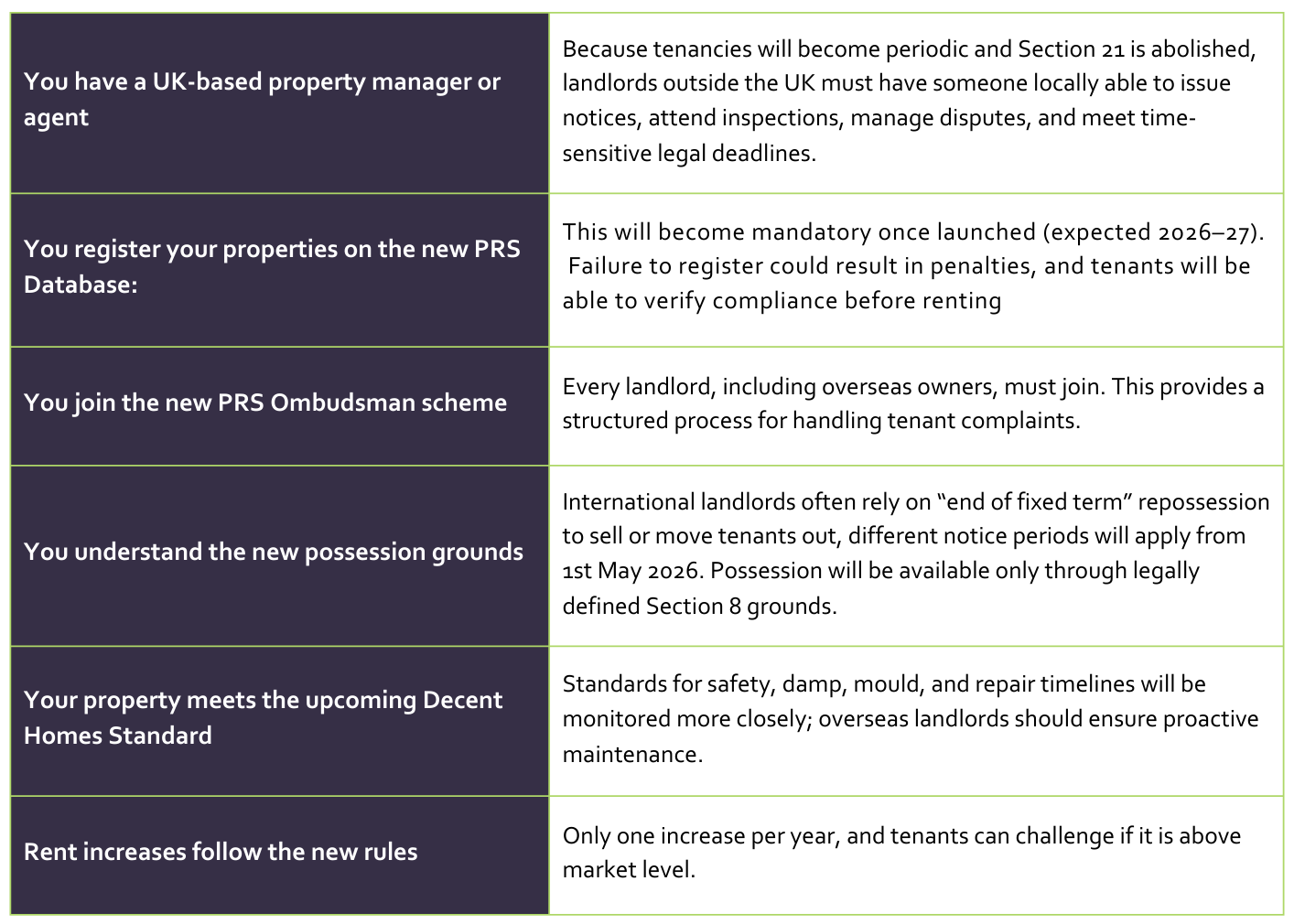
19. I am an international landlord – what do I need to do to stay compliant under the new Renters’ Rights Act?
International landlords are particularly concerned about changing legal processes and documentation. Under the Act, you must ensure:
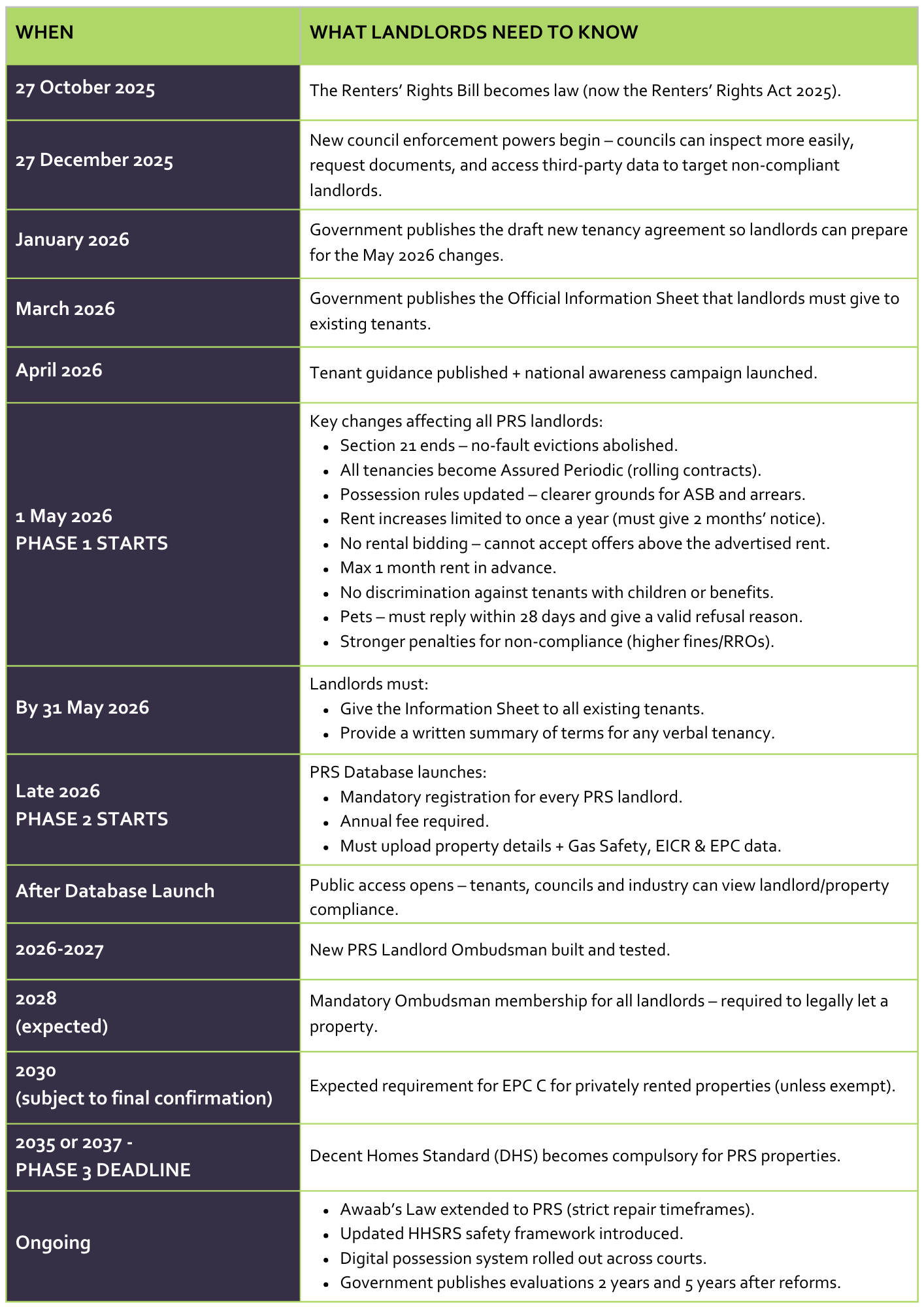
20. What does the Renters’ Rights Act roadmap look like, and when do the key changes take effect for landlords?
We have summarised the implementation roadmap below, but for more in-depth information on the Act, please visit the government website here.